

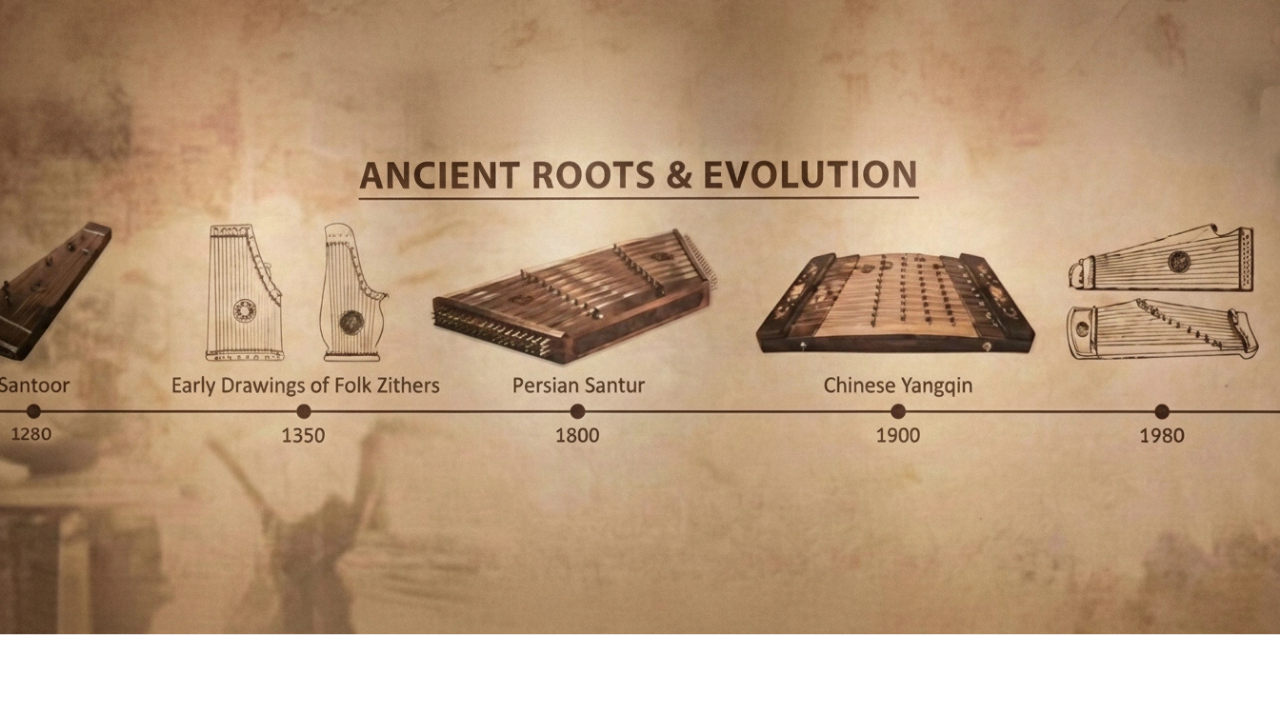
About the Santoor: Ancient Roots and Evolution
Quick Overview
The santoor, a trapezoidal hammered dulcimer with about a hundred strings stretched over moveable wooden bridges, is played with light walnut mallets to create a crystalline cascade of tones. Though now a celebrated voice in Hindustani classical music, its journey spans centuries and continents, from ancient Asia to its modern, raga-rich form.
Origins and Global Roots
Hammered zithers appear in some of the earliest musical records, from Mesopotamian reliefs to Persian court miniatures. In India, Sanskrit texts describe the shata-tantri veena—the “hundred-stringed lute.” In Kashmir, a folk version of this dulcimer enriched wedding songs, harvest dances, and Sufi gatherings. While relatives like the Persian santur, Chinese yangqin, and Hungarian cimbalom evolved separately, the Kashmiri santoor preserved a meditative timbre that would later suit Indian ragas.
Pt. Shivkumar Sharma and the Hindustani Renaissance
In the 1950s, Pandit Shivkumar Sharma transformed the santoor for Hindustani classical music—expanding its range, refining its bridges for smooth meend, and developing damping techniques for delicate microtones. His landmark 1955 Mumbai recital revealed the santoor’s lyrical potential, and over decades of performances and recordings, he secured its place alongside sitar, sarod, and bansuri as a luminous solo voice in North Indian classical tradition.
Advancing the Santoor Tradition
As one of the few female santoor soloists, Deepal is honored to extend this lineage by adding her own soulful voice to the hundred strings. She seeks to deepen and share this tradition, bridging its ancient resonance with today’s listeners and carrying its luminous legacy into the future.